
TUTORIELS
Retrouvez ici, les articles directement consultables, Article gratuit ou Article payant déjà payé ou Article payant pas encore payé
Subcategories
-

Acoustic diffusers
An acoustic diffuser is a device specifically designed to enhance the sound quality of a space. It is a precisely engineered architectural and technological element intended to uniformly disperse reflected sound waves within the room, thereby creating an acoustically favorable ambiance for precision listening.
From a technical standpoint, an acoustic diffuser serves several essential roles. Firstly, it minimizes undesirable sound reflections by diffusing sound waves that might otherwise induce echoes, resonances, or inappropriate absorption points in the room. This contributes to reducing sound coloration and improving acoustic clarity.
Furthermore, an acoustic diffuser helps establish controlled sound diffusion, signifying that sound is consistently dispersed in all directions rather than randomly bouncing off reflective surfaces within the room. This controlled diffusion aids in creating a sense of space and dimension, ultimately enhancing the spatialization and perceived audio quality.
In summary, an acoustic diffuser is a vital component in the acoustic treatment of a music studio as it promotes optimal sound quality by mitigating issues related to unwanted reflections and creating uniform sound diffusion. It is an essential technical tool for crafting an acoustic environment conducive to music creation, audio mixing, and precision listening.
-
Les Bass Trap
-
Le Placement des enceintes
-
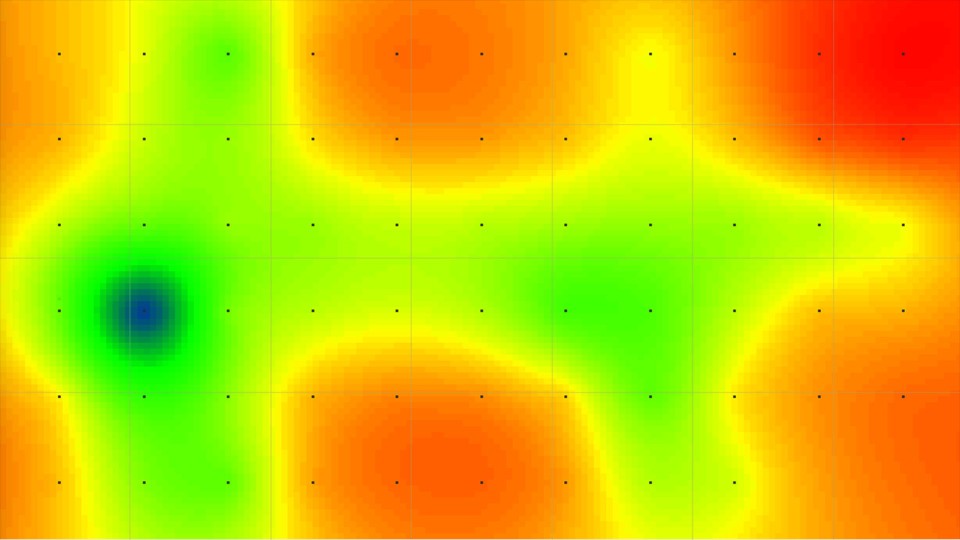
Les Résonances Modales
-
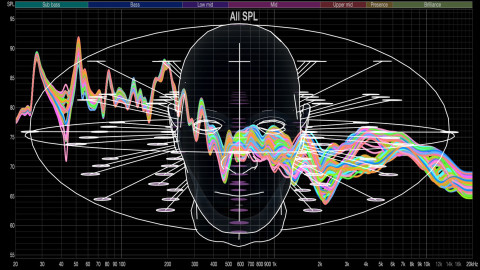
Electronic Acoustic Correction


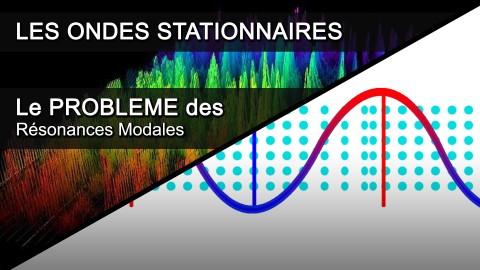
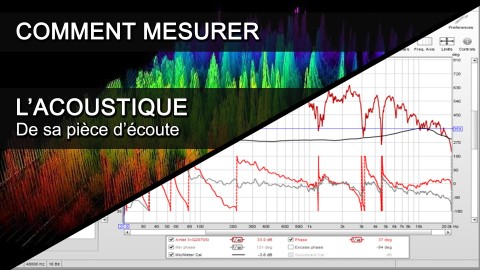
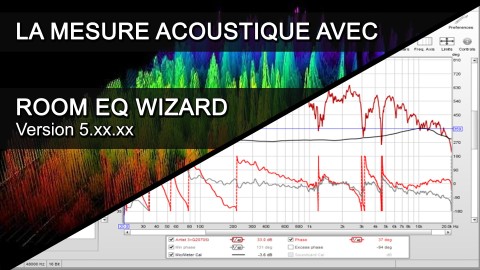
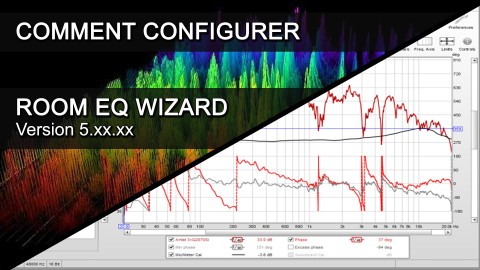
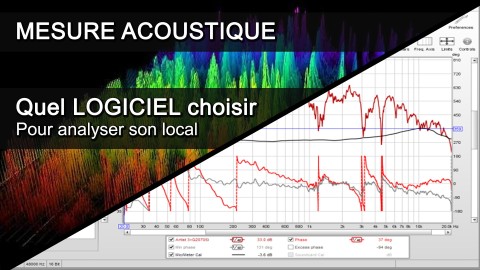
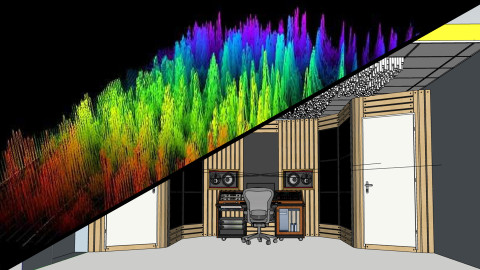
ACOUSTICS 00 - Sound treatment, acoustic treatment of your studio
Having excellent studio monitors, a great sound card, and a wide range of high-end equipment and plugins is certainly more than a good starting point for achieving professional-quality sound, but it actually represents only half of the journey required to achieve a high-quality mix.
Acoustic treatment of the room is an absolutely fundamental step to finally mix properly and gain precision in adjustments as well as save time during mixing.
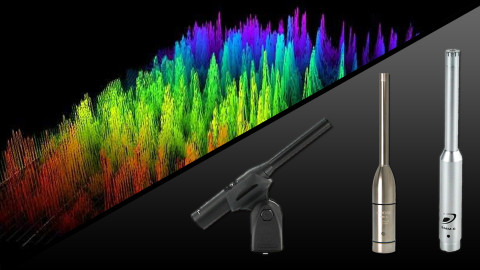
ACOUSTICS 01 - Which measurement microphone to choose?
Let me tell you right away, starting to treat a room without taking acoustic measurements is simply absurd.
Acoustic measurements are ESSENTIAL to understand what is happening in a listening room and are absolutely INDISPENSABLE for defining and choosing the materials needed for acoustic treatment of the room.
Therefore, the first FUNDAMENTAL thing you need to buy to start treating your room is not a bass trap, an acoustic foam kit, or anything else, but indeed a MEASUREMENT MICROPHONE!!!

DIFFUSER - The quest for the best acoustic diffuser, pioneers and studies
3 years of research, over 6,000 hours of study, experimentation, questioning of what has already been done in terms of diffusion, and the creation of about sixty diffuser devices made with different materials and sequences in order to understand, find, and achieve the best acoustic diffusers, have led me to develop my own method for simulating the behavior of a diffuser, a demonstration method based on observing a 'ripple tank,' a serious questioning of the certainties we had about their behaviors, and finally, my own distribution method, which varies depending on whether the diffuser design is based on rods or wells.
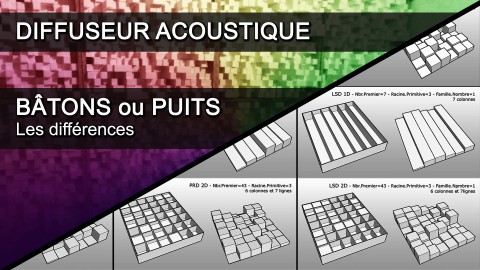
DIFFUSER - With Sticks or Wells, which design is the most effective ?
When it comes to diffusers, "experts" generally agree on a preference for well-based designs over stick-based ones. However, my investigations have led me to the conclusion that, depending on the sequence type and implementation constraints, stick-based designs often yield better results when the number of cells is substantial. After selecting the diffusers (generated randomly using the "Mersenne Twister") that exhibit superior characteristics to QRD, PRD, LSD, and PWRD models, in line with the predictions of my analyzer using the "brute force" method, I set out to examine the similarities in their designs to identify the elements necessary for optimal diffusion.